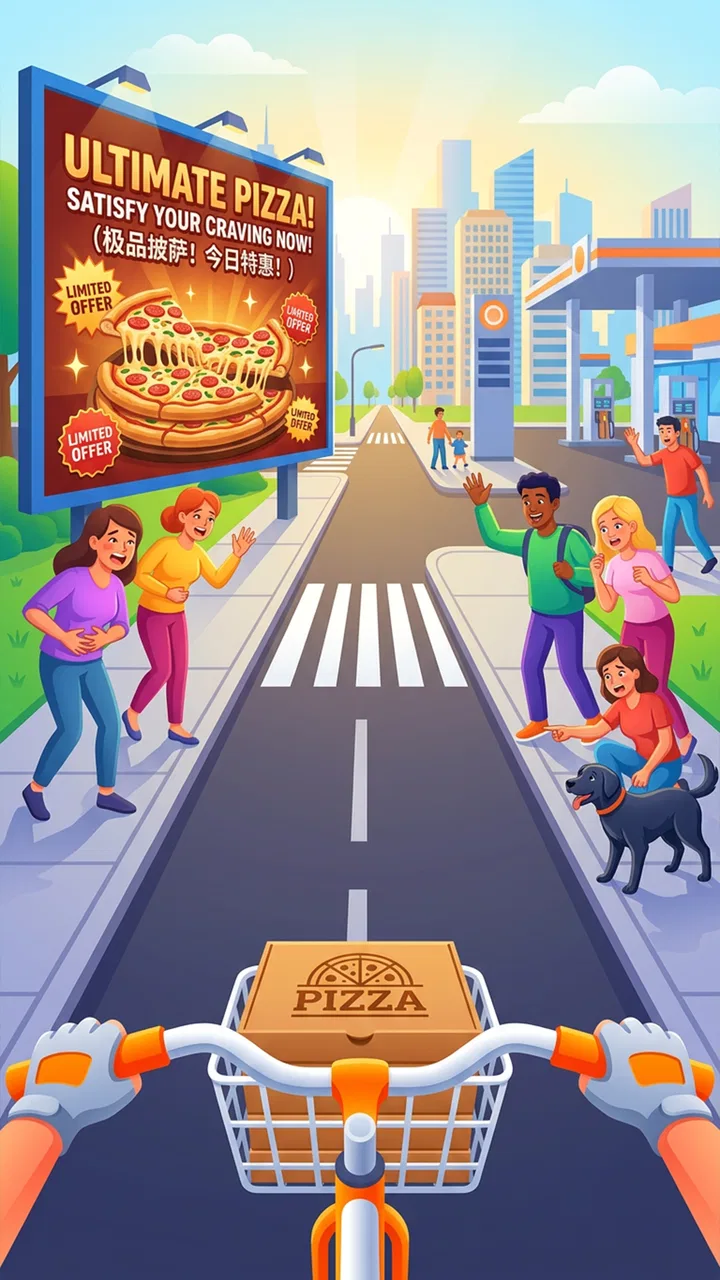
Pizza Dash: Moto Delivery
- 4.7
- Rating
- 5.00M
- Installs
- Free
- Price

 Analysis by App-foxy
I spent time with Pizza Dash: Moto Delivery, a free racing game from XGAME STUDIO built around one clear idea: weave through traffic, react to near misses, and get a pizza delivered before the road defeats you. That focus makes it easy to understand within seconds, but the simple premise hides a surprisingly demanding test of attention. This is not a traditional circuit racer with long menus, vehicle tuning, or a broad collection of racing disciplines. It is a compact traffic-dodging experience where the road itself is the challenge.
What kept me playing was the way the game turns a familiar delivery task into a sequence of quick decisions. I am not simply trying to go faster. I am watching the traffic, reading the arrows, choosing a gap, and judging whether a risky move will save time or end the run. The result feels closer to an arcade reflex game than to a full simulation, which is exactly why it works well for short sessions.
Following the arrows is the real challenge
I find that the arrows make each attempt feel less like simply dodging cars and more like planning a route under pressure. In this section, I’ll focus on how to read that guidance without letting it distract me from nearby traffic. A quick glance ahead can make the next move feel considered rather than rushed.
You May Also Like

 Blood Strike: 2.5 Anniversary
Blood Strike’s Loadouts Turn Every Drop Into a Tactical Gamble
A close look at Blood Strike’s custom loadouts: how fast access to signature weapons reshapes its battle royale rhythm, rewards preparation, and narrows the gap between fights.

 Pandora - Music & Podcasts
Pandora’s Music Is Easy to Start, but Harder to Recover
Pandora’s strength is its low-effort path from a seed to a station. Its weak spot is how much confidence it asks you to place in connection, setup, and quiet recovery.

 8 Ball Pool
 Is Built on Rivalries, Rematches, and Routine
A close look at the rivalries, rematches, shared routines, and unanswered safety questions that turn a quick pool match into a persistent mobile community.

 Samsung Music
’s Quiet Strength Is Playing What You Already Own
Its reach comes less from spectacle than from dependable access to a personal library. That simplicity is both the app’s strongest retention engine and its ceiling.

 AccuWeather: Weather Radar
AccuWeather Review: A Quick, Clear Forecast for Everyday Decisions
For everyday plans, the best forecast is the one you can understand quickly. AccuWeather makes rain timing, radar, and local conditions easy to act on, with a few trade-offs.

 Hill Climb Racing
Why Hill Climb Racing Still Turns Crashes Into One More Run
A tiny car, a bumpy hill and one more upgrade: Hill Climb Racing keeps resurfacing because its simple chaos makes every near-miss feel personal.
More From Our News Desk



A focused racing idea
The most important capability here is the combination of directional guidance and near-miss traffic dodging. The arrows give me a route to follow, while the surrounding vehicles create the pressure. That pairing changes the experience from simply moving forward to constantly balancing destination and survival. If I focus only on the next arrow, I can miss a vehicle entering my path. If I watch traffic without checking the route, I can lose the intended line.
That split attention is where the game earns its racing label. The delivery theme gives the action a purpose, but the real skill lies in reading movement quickly. I found myself making decisions in layers: first identifying where the route points, then checking which lane is safest, and finally deciding whether there is enough space to pass. The game feels most satisfying when those choices become automatic rather than hesitant.
This design also makes the experience approachable. Someone who rarely plays racing games can understand the objective immediately. There are no complicated racing terms to learn before starting, and the pizza delivery setup gives every run a recognizable goal. At the same time, players who enjoy reflex challenges have a reason to improve because safer driving is not always the quickest driving.
Why near misses matter more than raw speed
In many mobile racing games, the obvious instinct is to hold the fastest line and worry about braking later. Here, that approach can be too careless. Traffic turns every opening into a question. A narrow gap may be tempting, but entering it while also trying to follow the arrows can create a chain of bad decisions. I learned to treat a near miss as a controlled choice rather than an accident I hoped to survive.
That distinction is useful for new players. Instead of trying to move constantly, I recommend watching the rhythm of the road for a moment. Traffic often creates patterns: one opening looks attractive, then another vehicle closes it. Waiting briefly can be better than committing to a gap that disappears. The game rewards attention more than frantic movement, even though the action itself feels fast.
The strongest part of Pizza Dash is not the delivery story; it is the pressure of making a safe route look fast. That is the capability I kept noticing during play, and it gives the game a clearer identity than a generic motorcycle racer would have.
How the arrows change the way I play
The directional arrows are more important than a decorative guide. They give me a visual priority while the traffic competes for my attention. I found it helpful to glance at them before making a move instead of reacting only when the route changes. That small habit reduces sudden swerves and makes the next decision feel deliberate.
There is also a practical trade-off between staying close to the suggested direction and taking a more aggressive line. A direct route may expose me to more traffic, while a cautious adjustment can cost momentum. Because of that, I stopped treating the arrows as an instruction to move immediately. I use them as a preview of what the road is asking me to do next.
This is one of the game’s less obvious lessons: visual information has to be processed before it becomes useful. Players who stare at the nearest vehicle may survive the current moment but be unprepared for the next turn. Players who look too far ahead may fail to notice the immediate obstacle. The best rhythm is a short scan between the route and the traffic.
What a typical run feels like
A run works best for me when I treat each opening as a decision, not an automatic invitation to move. Here I’ll describe the rhythm of checking the route, judging traffic, and choosing when to commit, including why a brief pause can be more useful than constant corrections. That rhythm also helps explain which everyday moments suit the game.
Starting with a simple routine
When I open the game, I approach each attempt with a small routine. I first identify the arrow direction, then I check the closest traffic, and only after that do I choose how aggressively to move. This takes almost no time once it becomes familiar, but it prevents the most common mistake: reacting to a vehicle before understanding where the route is going.
The short-session design suits that routine. I can play while waiting for a coffee, during a brief break, or when I want something more active than a puzzle but less demanding than a long racing campaign. A run does not require me to remember a complicated story or prepare a vehicle setup. I can start with the immediate task of reading the road.
That convenience is also why the game feels more like an arcade challenge than a conventional racer. It is built around repeated attempts and gradual improvement. I am not playing to admire a long track layout or compare a large garage. I am playing to make better choices than I made a few moments earlier.
A realistic everyday scenario
Imagine having ten minutes before an appointment. A large racing game may ask you to load through several screens, select a mode, adjust a vehicle, and commit to a longer event. Pizza Dash fits a different moment. I can launch it, concentrate on traffic and arrows, finish a quick attempt, and put the phone away without feeling that I abandoned a major race halfway through.
It also works well when I want a game that does not require sound to be the main source of information. The important decisions are visual: route direction, vehicle position, and the size of the available gap. That makes it practical for a quiet public place, provided I am comfortable giving the screen my full attention for the duration of a run.
The catch is that “quick” does not mean effortless. A short attempt can still demand concentration. I would not start it while walking, crossing a road, or doing anything else that needs awareness, because the traffic patterns encourage close visual focus.
Small habits that improve consistency
My first useful habit was to avoid treating every opening as an invitation. The safest gap is not always the most obvious one, especially when the arrows suggest a change in direction. I get better results by identifying the next two decisions instead of only the next vehicle: where I need to go, and what space will remain after I move.
A second habit is to keep movements purposeful. Repeated corrections make it harder to judge the road because I am responding to my own previous movement as much as to the traffic. A cleaner approach is to choose a line, observe whether it remains open, and adjust only when the situation genuinely changes.
A third tip is to use failed attempts as information. If I collide after following an arrow, I ask whether the problem was poor timing, an overly narrow gap, or looking at the route too late. That turns repetition into practice instead of random retrying. The game’s compact premise makes this kind of self-correction easy to apply.
The best situation for playing
I’d pick this game when I have a short, uninterrupted break and can keep my attention on the screen. The next section looks at practical situations where its focused delivery challenge fits—and where playing would be a distraction rather than a welcome diversion. That distinction matters more than the length of a session.
Who will enjoy the delivery pressure
I think the game is best for players who like arcade racing with immediate feedback. If you enjoy games where a small improvement in timing feels meaningful, the traffic-dodging focus gives you plenty to work on. It is also a good fit for people who prefer a single clear objective over a long list of modes and systems.
The Everyone content rating makes the basic concept suitable for a broad audience, including younger players who want a straightforward racing challenge. Adults may appreciate it for a different reason: it is easy to pick up without requiring a large time commitment. The pizza theme keeps the presentation light, while the road still provides enough tension to prevent the game from feeling passive.
It is especially appealing if your usual racing games feel too elaborate. Someone who wants deep vehicle customization, realistic handling, or a detailed career structure will probably find this experience narrow. Someone who wants to test quick reactions without learning a complex system may find that narrowness refreshing.
Why it suits short breaks better than long sessions
The game’s central loop is naturally repeatable, but it does not offer the same kind of variety as a broad racing package. I can play several attempts in a row, yet the appeal depends on whether I enjoy refining my traffic decisions. For me, the best sessions are short enough that the focused design stays sharp.
During a longer session, the repeated road-reading can become mentally tiring. That is not necessarily a flaw; it is a sign that the game is asking for active concentration rather than background play. Still, players who want a relaxing racer to leave running while they casually tap may prefer a slower alternative.
The most effective use is to set a small personal goal: make fewer reckless moves, follow the arrows more cleanly, or survive a difficult sequence without improvising at the last second. Those goals give each attempt a purpose without requiring a formal progression system to keep me interested.
Where the trade-offs become clear
The game’s tight focus is its main appeal, but it also sets clear limits on what kind of racing experience it can offer. I’ll weigh that concentrated traffic challenge against the broader variety some players expect from racing games, then consider how the optional purchases affect the decision to keep playing. My view depends on whether the core loop is what you came for.
Simple focus versus broader racing variety
Pizza Dash gains its identity from doing one thing clearly, but that also limits its range. Compared with kart racers, it does not offer the same emphasis on character abilities or playful track hazards. Compared with realistic motorcycle games, it does not aim for detailed vehicle behavior. Compared with endless runners, it adds route guidance and a delivery objective rather than relying only on distance and obstacle avoidance.
That comparison helps explain who should choose it. If I want a broad collection of race types, I would look elsewhere. If I want an uncomplicated traffic challenge that I can understand immediately, the focused design is an advantage. The game is not competing with every racing subgenre at once; it is strongest when judged as a quick route-reading test.
Free access and the purchase question
The game is free to download and play, with optional in-app items priced from $0.99 to $9.99 each. That makes it easy to try without committing money first, but I still recommend paying attention to how those purchases fit your habits. A player who is happy to repeat attempts may have little reason to spend. A player who wants to move through the experience more quickly may view optional items differently.
My advice is to play enough free sessions to decide whether the core traffic loop is enjoyable before considering any purchase. No item can replace the central skill of reading the arrows and judging gaps. If the basic movement does not feel satisfying, spending will not solve that problem. The purchase range is reasonable to note because the game’s value depends heavily on whether you enjoy repetition rather than on how quickly you can bypass it.
Device expectations and current build
The game supports Android devices running version 7.0 or later, which covers a wide range of phones. I would still choose a device that responds reliably to quick input, because delayed or imprecise control would make traffic decisions feel unfair even when the underlying challenge is reasonable.
The current version is 1.4.1.1. When installing, I would check that the phone has enough free space and that the operating system meets the requirement before troubleshooting a problem that may simply be compatibility-related. These are small practical steps, but they matter more in a reflex game than in a turn-based title.
Another trade-off is attention. The game looks approachable, yet near-miss driving is not something I can do effectively while multitasking. It is a poor choice for a situation where I need to keep looking away from the screen. For a focused break, it works well; for background entertainment, it does not.
Who gains the most from this game?
The clearest audience is the player who wants a free mobile racing game with a tight central skill. You will probably get the most from it if you enjoy learning traffic patterns, making quick route decisions, and replaying a challenge until your timing improves. The delivery theme adds personality without burying the action under extra systems.
It is also a sensible recommendation for a friend who says full racing games feel like too much work. I can explain the objective in one sentence, and the first attempt teaches the basic relationship between arrows and traffic. That accessibility does not remove the challenge; it simply places the challenge where it belongs, in the decisions made during the run.
The game has already reached over 5 million installs and holds a 4.7 average from around 6 thousand ratings, which suggests that its straightforward approach connects with a substantial mobile audience. I would treat those figures as a sign of broad appeal rather than proof that every racing fan will enjoy it. The experience remains specialized, and its repetition will not suit everyone.
Players should skip it if their priority is simulation depth, multiplayer competition, extensive customization, or a long-form racing career. They may be happier with a title designed around those features. Pizza Dash is better for someone who values instant access and a focused reflex challenge over a large content catalogue.
My final take after repeated deliveries
I like Pizza Dash because it understands its strongest idea and keeps returning to it: follow the route, read the traffic, and decide how much risk a fast delivery is worth. The arrows are more than guidance, and the near misses are more than decoration. Together, they create a small but effective decision-making loop that rewards patience as much as speed.
My recommendation is to approach it as an arcade practice game, not as a complete motorcycle racing replacement. Use short sessions, watch the next route change before committing to a gap, and treat collisions as clues about timing rather than reasons to play recklessly. That approach makes the game feel more controlled and gives the repetition a purpose.
Developed by XGAME STUDIO and released on Jul 27, 2025, it is a free option for Android users who want a light delivery theme wrapped around demanding traffic reactions. The Everyone rating makes it broadly approachable, while the optional purchases mean players can decide for themselves whether the free loop is enough. For me, it is worth trying when I want a quick race that tests attention without asking me to manage a garage, a campaign, or a complicated rulebook.
Pizza Dash: Moto Delivery is at its best when I have a few uninterrupted minutes and want a challenge I can understand immediately but not master immediately. It will not replace a full racing game, and it should not try to. Its value comes from the narrow focus: every arrow and every gap matters, and a successful delivery feels earned because I made the road work in my favor.
FAQs for Pizza Dash: Moto Delivery
01What is Pizza Dash: Moto Delivery?
Pizza Dash: Moto Delivery is a fast-paced, arcade-style game where players take on the role of a pizza delivery driver. The objective is to deliver pizzas as quickly as possible while navigating through traffic and obstacles. The game combines elements of strategy and skill, providing an exciting and engaging experience.
02Is Pizza Dash: Moto Delivery free to play?
Yes, Pizza Dash: Moto Delivery is free to download and play. However, it offers in-app purchases for additional features, such as unlocking new bikes, customizing characters, or acquiring power-ups to enhance gameplay. These purchases are optional and not necessary to enjoy the full experience of the game.
03What are the system requirements for Pizza Dash: Moto Delivery?
Pizza Dash: Moto Delivery is compatible with most modern Android and iOS devices. It requires iOS 10.0 or later for iPhone and Android 5.0 or higher. The game is optimized for performance, but it's recommended to have at least 1GB of RAM and a stable internet connection for the best experience.
04Can I play Pizza Dash: Moto Delivery offline?
While Pizza Dash: Moto Delivery offers some offline functionality, certain features require an internet connection. For example, accessing leaderboards, participating in special events, and syncing progress across devices need connectivity. However, the core gameplay can be enjoyed without an internet connection once the game is installed.
05How can I control the bike in Pizza Dash: Moto Delivery?
Pizza Dash: Moto Delivery offers intuitive controls designed for touchscreens. Players can tilt their device to steer the bike or use on-screen arrows for navigation. There are also buttons for accelerating and braking. The game provides a quick tutorial at the start to help players familiarize themselves with the controls.
Pros
- Engaging gameplay with challenging levels.
- Intuitive controls and smooth graphics.
- Diverse range of delivery scenarios.
- Customizable bikes and outfits.
- Regular updates with new features.
Cons
- Occasional in-app purchase prompts.
- Ads can interrupt gameplay.
- Requires stable internet connection.
- Limited offline features.
- High battery consumption on older devices.

Pizza Dash: Moto Delivery
Gallery